

Quick Overview
If you own a plot or a house in one of Indore’s “illegal” colonies, there’s a fair chance you’ve spent years worrying about what happens to your investment. On Tuesday, August 18, 2026, the Indore Municipal Corporation’s Mayor-in-Council, headed by Mayor Pushyamitra Bhargav, cleared a decision that directly affects thousands of such property owners: you can now open a property tax account for your plot or house even if it sits inside an unauthorized colony, provided you can show clean ownership papers. It’s not a full regularisation, and it’s not a free pass either, but it’s a meaningful first step, and here’s everything you need to know about it in plain language.
So What Exactly Did IMC Approve?
Cutting through the municipal jargon, the decision boils down to this: the IMC will now let owners of privately held plots and built-up properties inside unauthorized colonies open a formal property tax account, as long as they can produce complete ownership documents. Once that account is opened, the owner starts paying property tax on the asset just like any regular, sanctioned colony resident would.
Alongside this, the MiC also approved a Standard Operating Procedure (SOP) to simplify the property mutation process across the city, meaning transferring a property from one owner’s name to another should get faster and less painful going forward.
There’s an important catch worth flagging early: this benefit is only for privately owned land and structures. If your property sits on encroached government land, this framework does not apply to you, and no tax account will be opened for such encroachments.
Why Is This Happening Now?
Indore’s unauthorized colony problem isn’t new; it’s been building for decades as the city expanded faster than its planning authorities could formally sanction layouts. Here’s why the timing makes sense:
- A stalled regularisation drive. Earlier in 2026, the IMC had been working to formally regularise more than 450 unauthorized colonies across the city, building on roughly 200 colonies it had already cleared in previous phases. That process hit real roadblocks: objections from agencies like the Nazul office, Indore Development Authority, Town and Country Planning department, and the Housing Board over land-use conflicts, urban land ceiling issues, and missing approved layouts slowed things down considerably.
- Revenue the city badly wants. With full-scale regularisation tangled in inter-departmental red tape, opening tax accounts is a faster, lower-friction way for IMC to start collecting revenue from thousands of properties that have effectively been sitting outside the formal tax net.
- Pressure from residents. Owners in these colonies have long complained about being denied basic recognition — no formal tax receipts, difficulty getting loans, and constant uncertainty about their property’s status. A tax account, even without full regularisation, gives them a paper trail.
- A pattern seen elsewhere. Delhi went through something similar, first offering tax relief and tax-account facilities to unauthorized colonies before eventually moving toward an “as is, where is” regularisation. Indore appears to be borrowing from that playbook: start with taxation and documentation, sort out the layout approvals later.
Who Does This Affect?
This is the part most people skim past, so let’s be specific about who actually benefits and who doesn’t.
You’re likely covered if:
- You own a private plot or built-up house inside a colony that developed without formal IMC/IDA layout approval.
- You have documents that establish a clean chain of ownership sale deed, registry papers, GPA, or similar proof.
- Your property is not sitting on government, Nazul, or ceiling-surplus land.
You’re probably not covered (yet) if:
- Your structure is an encroachment on government-owned land.
- Your colony falls in a green belt, water body buffer, or a zone under active dispute between IDA, Housing Board, and IMC.
- You don’t have any ownership documentation to show at the counter.
Who benefits the most from this move, practically speaking:
- First-time buyers and long-term residents in colonies like those in the outer wards, who’ve wanted a formal tax receipt for years to use as address/ownership proof.
- Property owners planning to sell or mortgage, since a tax account and paid receipts add a layer of credibility, even short of full regularisation.
- The IMC itself, which gains a new, meaningful revenue stream without having to first untangle every legal knot around 450-plus colonies.
Not sure whether your colony or plot qualifies for a tax account under this new rule? At Samprati Properties, our Indore-based team helps property owners check documentation, verify colony status, and navigate IMC procedures — feel free to reach out before you head to the ward office.
The Bigger Picture: Where Colony Regularisation Actually Stands
To understand why IMC chose this middle path, it helps to see how far the full regularisation drive has (and hasn’t) progressed.
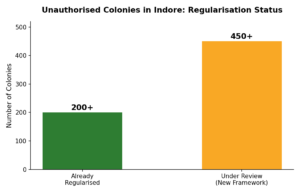
The chart below shows where things stood as the tax-account decision was approved: a little over 200 colonies fully regularised in earlier phases, against 450-plus still stuck in review because of inter-agency objections.
Given that gap, it’s easier to see the logic: rather than waiting for every one of those 450+ colonies to clear zoning and layout objections, IMC is letting private owners start paying tax right away, and worrying about full legal regularisation as a separate, longer track.
How Property Tax Actually Works in Indore (So You Know What You’re Signing Up For)
Once your account is opened, you’ll be paying under IMC’s existing Unit Area Method, which is used across the city’s six tax zones — from the older, congested Rajwada-Sarafa belt to the newer peripheral wards. A few practical numbers worth knowing for FY 2026-27:
- Property tax generally ranges between 1% and 6%, depending on your zone and property use.
- The due date for the year is June 30, but paying before May 31 earns you a 6.5% early-payment rebate (plus 6% on water bills).
- Filing an online self-assessment adds another 5% rebate, so early, self-assessed payments can save you up to 11% combined.
- Miss the deadline, and a 2% per month late penalty kicks in from July 1 onward.
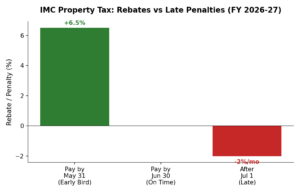
Here’s how that timeline looks side by side:
What You Should Actually Do Next
If your property falls under this new provision, here’s a realistic checklist rather than vague advice:
- Pull together your ownership documents — sale deed, registry copy, any GPA or possession letter you have. Incomplete paperwork is the single biggest reason applications get stuck at the ward level.
- Visit your local IMC zonal office or check the official IMC portal (imcindore.mp.gov.in) or the MP e-Nagar Palika platform to ask about opening a property tax account under this new decision.
- Confirm your land status isn’t government/Nazul land before you invest time; the framework explicitly excludes encroachments on public land.
- Keep an eye on the mutation SOP IMC is preparing; once it’s out, transferring your property or updating ownership records should become noticeably simpler.
- Don’t confuse this with full regularisation. A tax account gets you into the formal system and gives you paper proof of payment, but layout sanction, building permissions, and full legal status are still separate processes that the larger 450 colony drive is meant to address.
Quick Reference Table
| Detail | What It Means For You |
| Approved by | IMC Mayor-in-Council, chaired by Mayor Pushyamitra Bhargav |
| Date approved | August 18, 2026 |
| Who qualifies | Private plot/property owners in unauthorized colonies with clean documents |
| Who’s excluded | Encroachments on government/Nazul land |
| Related change | New SOP to simplify property mutation |
| Existing tax method | Unit Area Method, 6 zones, 1%–6% rate range |
| Early payment benefit | Up to 11% combined rebate if paid and self-assessed before May 31 |
| Late payment cost | 2% penalty per month from July 1 |
Samprati Properties tracks Indore’s real estate and civic policy updates closely so our clients never miss a change that affects their property’s value or paperwork. Have questions about a specific colony or plot? Talk to our team.

Samprati Properties is a name built on trust and expertise in Indore’s real estate market. We go beyond transactions by focusing on long-term relationships and genuine guidance.
About Us